PSA 007.5
The Principal of Incomensurability


I recently got a question about my 4th assertion in PSA 007 and decided to post my thoughts in a part 2 of sorts….

“There is an emerging principal of incommensurability with systems becoming synonymous with survivability facing systems that is increasing with the further cyberization of weapons.”
So the question was, what the heck does this mean? I realize this isn’t close to what one might find in FM 3-0. It has a lot to do with how I see the trajectory of warfare at the moment.
First then, an analogy. When you were in grade school, did you ever try doing this?
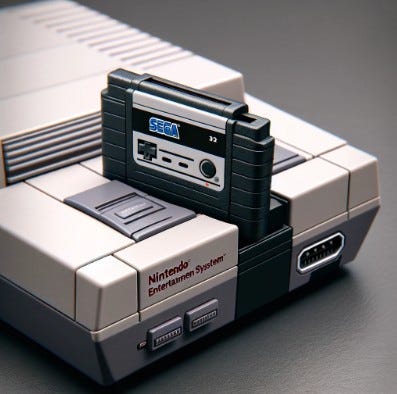
And yes, that’s an AI image. Apparently no one recorded their childhood attempts to jam a sega cart into an NES, this was much harder to find on google images than I anticipated. To spoil the ending for you, it didn’t work. And yes, this resulted in some beat downs for us sega guys in an NES loving grade school. Sega games were not compatible with NES.
Another analogy, since the sega master system and NES are probably too old for all of you. While most of us laugh at Apple users, ever heard the Apple selling point that you don’t have to worry about malware or viruses on a MAC like you do on a Windows computer? That’s because Windows is not compatible with MAC, they don’t talk, so MAC is immune to viruses on Windows.
Things are incommensurable when they cannot be compared due to lack of a common standard of measurement or an inability to be judged by the same criteria. We can consider it to be the opposite of interoperability as understood in present-fashionable military jargon.
In warfare this means determining what activates a sensor’s switch, or what starts a process in motion. Simply evading this makes your attack invulnerable to the defender, and the greater the defender’s technological edge, the greater his vulnerability. Today’s militaries are fraught with process and tech. Processes like F2T2EA, or the Joint Targeting Cycle. Tech like MQ-9 Reapers or micro drones, and the C4I systems that capture and process their data.
When we cross a certain threshold of processes and tech, they tend to make US binary ourselves, boxing ourselves into the thinking patterns they allow to us, and that is clearly a vulnerability. This is happening now, and as tech accelerates the impact of this vulnerability deepens.
Consider some real world examples. Chinese balloons going undetected in American airspace while floating in plain sight, simply because our radars were not calibrated to display their tracks, as I talked about here

I’ve been deliberately avoiding the politically charged subject of operations in Gaza, but how did a unit of Hamas paragliders slowly float through Israeli airspace and wreak devastating havoc inside their target territory despite a wall of Iron Dome air defense batteries? You could see them with the naked eye on the chilling smartphone camera livestreams we saw that day. The same reason as the sino-balloons, this type of attack simply existed outside of anyone’s defense framework.

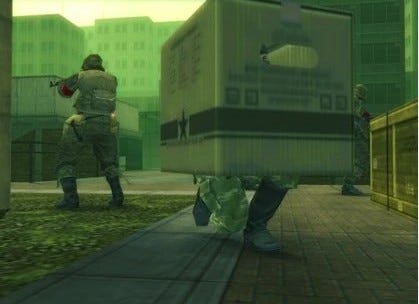
A more blatant example would be last year’s comical DARPA drone being thwarted by marines in cardboard boxes.
And this is the unavoidable future. Demands of the battlefield along with the economic inertia of defense contractors advancing tech must inevitably cyberize our ranks. Ironically, armies less subject to market forces driving tech, with dynamic human creativity and strength of will, will find ways to thwart these systems as absolutely as a computer hacker gains root access to a target.
This principal of incomensurability scales from the tactical edge to the strategic level of warfare. If one’s approach to battle is different enough from their adversary’s that they cannot be quantified inside their adversary’s framework, they are invulnerable. At the strategic level this could be the Chinese concept of lawfare, or even their approach to global trade as another way to exploit the Rules Based Global Order.
So, isn’t this just surprise? What’s the difference between what I’m talking about and any other surprise attack? ADP 3-90 speaks a bit to surprise,
“Commanders surprise enemy forces by attacking at a time or place or in a manner for which enemy forces did not prepare or expect.” (p.3-2 para 3-7).
The difference between this and surprise is that you cannot surprise a machine. A machine does not expect you to be in a place or of a particular disposition. A machine executes a routine of steps in its code, and if a particular input mechanism that it has is triggered, the machine functions.
You can no more surprise a drone that you can surprise your air fryer by pressing stop before time on your chicken tendies. You can no more surprise a unit completely reliant on processes and AI than you can surprise the New York Stock Exchange. Only humans can experience surprise because only we can make and understand context. Context can only come from the light of the human mind (assertion 3). The dynamic changes significantly here when you begin to think about it this way.
This is not to imply that we should strive to create a force that can’t talk to anything the enemy or itself has, that would be silly. This is to say that incomensurability must be considered along with interoperability in planning and executing operations on the modern battlefield, and perhaps with an emphasis on the former more so than the latter. It is a principal.
I think this should clear it up a bit; now you know. And knowing is half the battle (the other half is violence).
Yo joe!